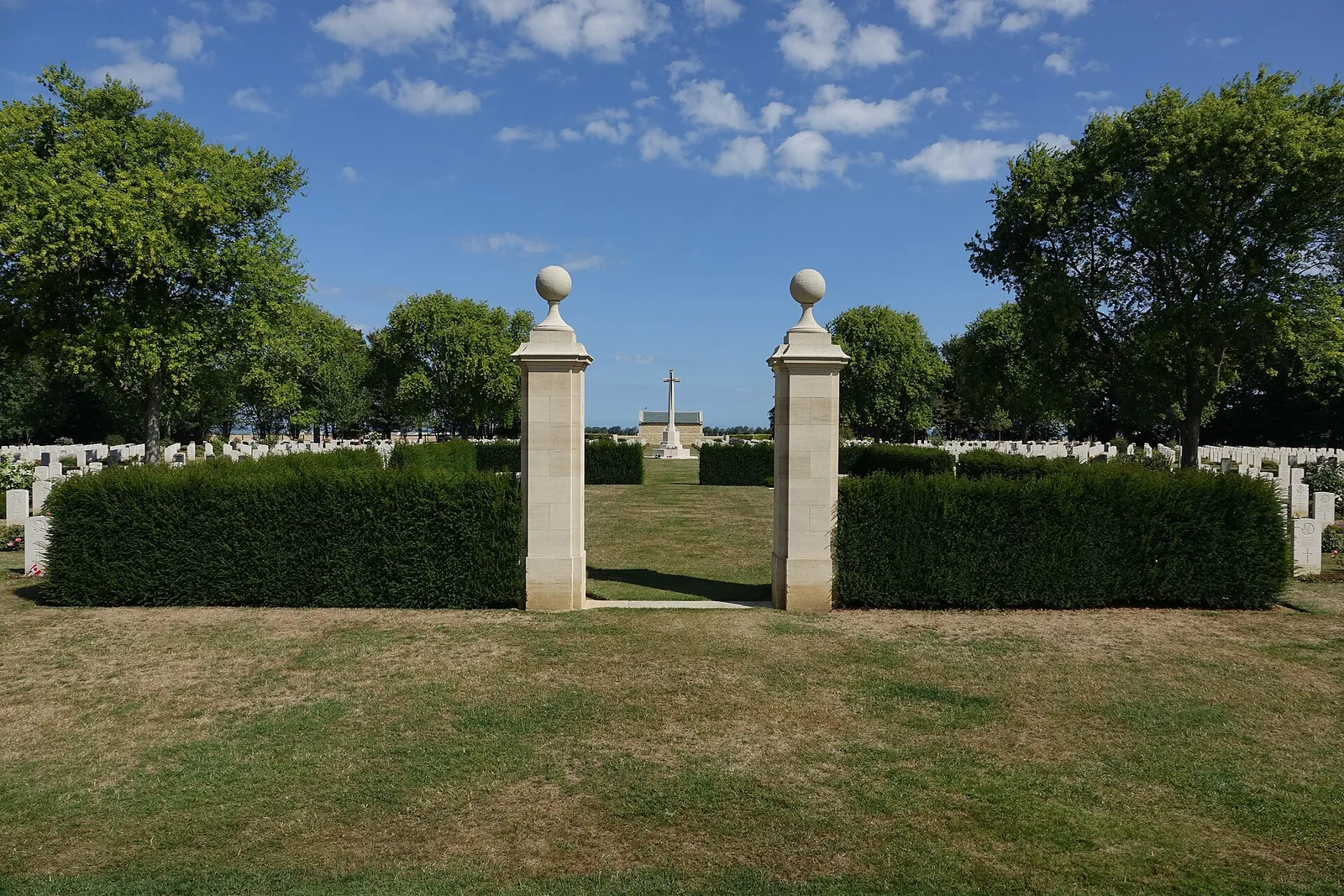
Bény-sur-Mer Canadian War Cemetery holds "2,049 headstones enclosed by pines and maples", according to Veterans Affairs Canada. They include the 335 soldiers of the 3rd Canadian Division who landed on Juno Beach on 6 June 1944, notes the Cœur de Nacre tourist office. Most of the men buried here died in June and early July 1944, during the battle for Caen.
The cemetery is open all year, admission is free and there is free parking at the gate. It actually sits in the commune of Reviers, a 12-minute drive from Anisy. The one thing that needs planning is the search itself: finding a single grave among more than two thousand is far easier with its reference in hand. Here is how to get that reference, how to read a headstone, and how to build a day around the visit.
Who is buried at Bény-sur-Mer Canadian War Cemetery?
The cemetery bears the name of Bény-sur-Mer, yet it lies near the village of Reviers. The local mayor and residents regard it as their own, Veterans Affairs Canada writes. Canada suffered almost a thousand casualties on D-Day, of whom 340 were killed or died of wounds, according to the same page.
Key points:
- The number: 2,049 graves, cared for by the Commonwealth War Graves Commission, the CWGC (Cœur de Nacre).
- The airmen: 15 airmen of various nationalities also rest here, with three British soldiers and one French soldier (Normandy Tourism).
- The origins: the CWGC lists men from Canada, Newfoundland, the United Kingdom, the USA, Cuba and British Guiana (CWGC school resource).
- First Nations: the same CWGC resource names Harold Littlecrow as one of several First Nations Canadians buried here.
- Ardenne Abbey: Canadian prisoners of war executed at the abbey in June 1944 are buried here, Cœur de Nacre notes.
- The origin of the site: at the end of 1944, two permanent Canadian cemeteries were set up in Normandy, this one and Bretteville-sur-Laize, south of Caen, says Normandy Tourism.
Visiting Bény-sur-Mer Canadian War Cemetery: the layout
The cemetery stands on the D35 road, north of Reviers (Cœur de Nacre, Reviers page). The same page puts the village about three kilometres from Juno Beach. Once through the gate, everything is arranged along one central path, which makes the plan easy to follow.
The entrance and the registry buildings
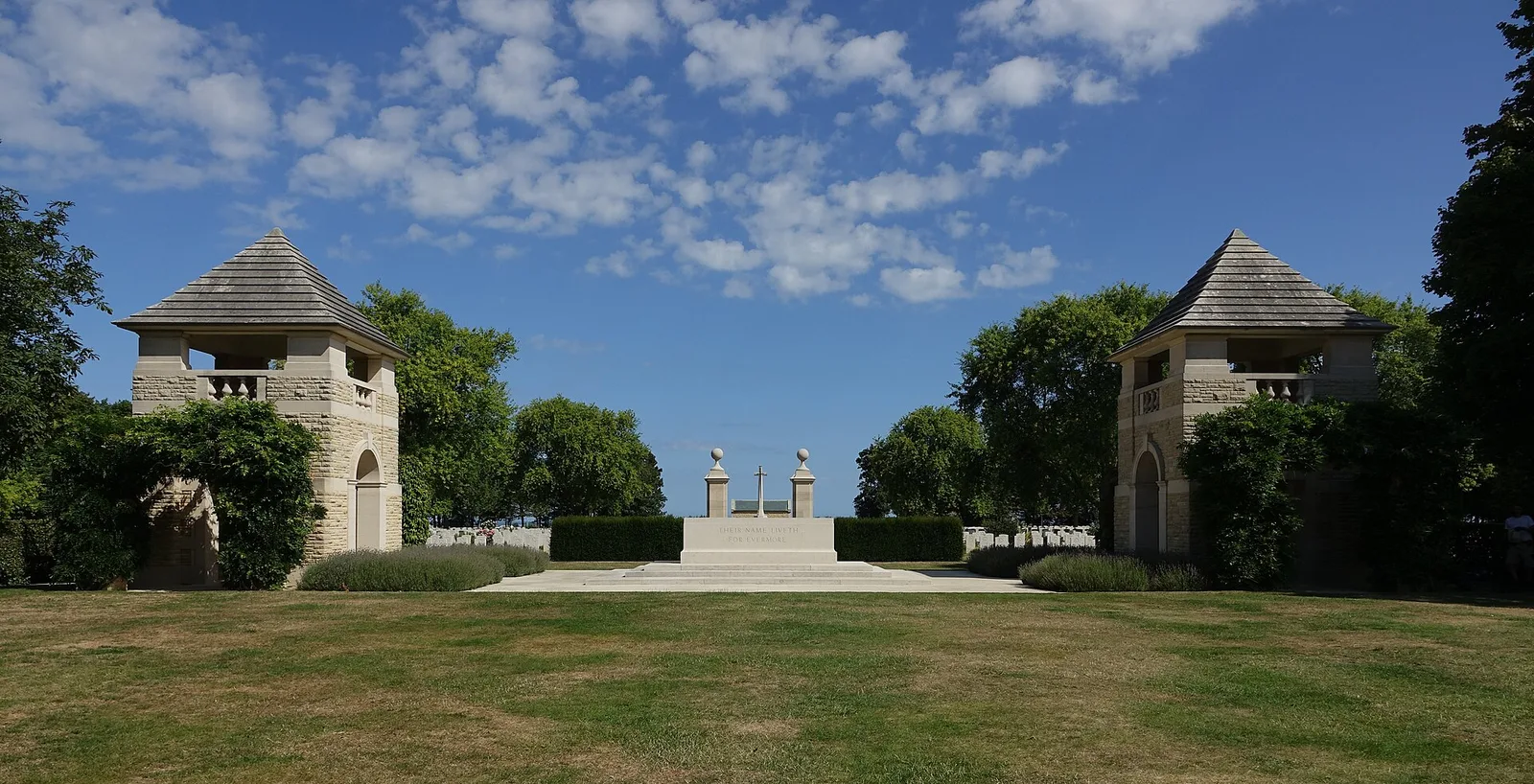
Fine hedges decorate the entrance, and the flanking registry buildings each carry a platform from which you can see the whole cemetery, according to Veterans Affairs Canada. The French version of the same page adds that the view reaches across the surrounding countryside. Take a few minutes up there before walking down to the rows: the plan makes more sense from above.
The Stone of Remembrance and the Cross of Sacrifice
The central path leads first to the Stone of Remembrance, then to a place of contemplation, the Cross of Sacrifice and finally the gardener’s shelter, Normandy Tourism describes. The quiet space halfway along the path is a natural place to pause before looking for a row.
The rows of headstones
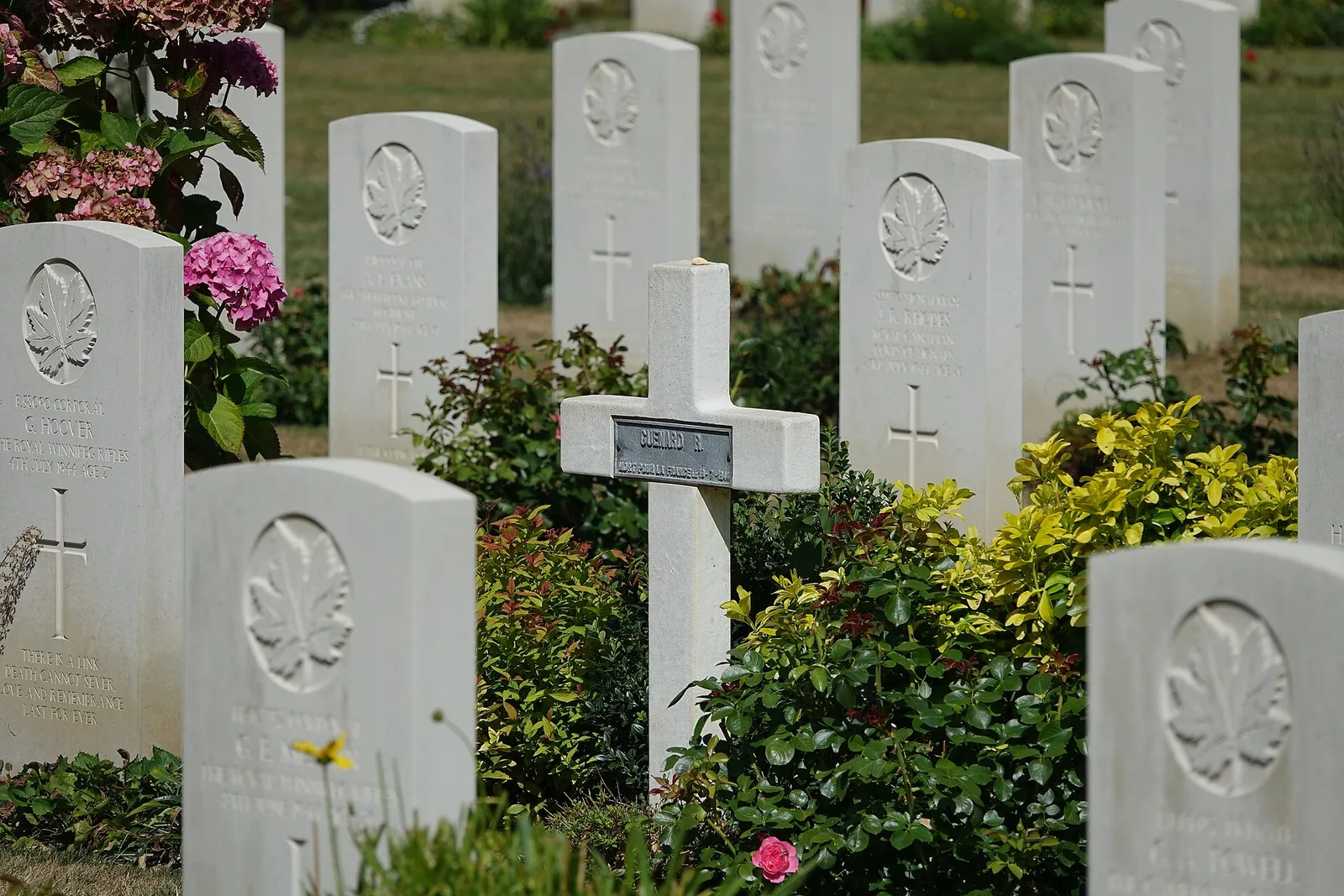
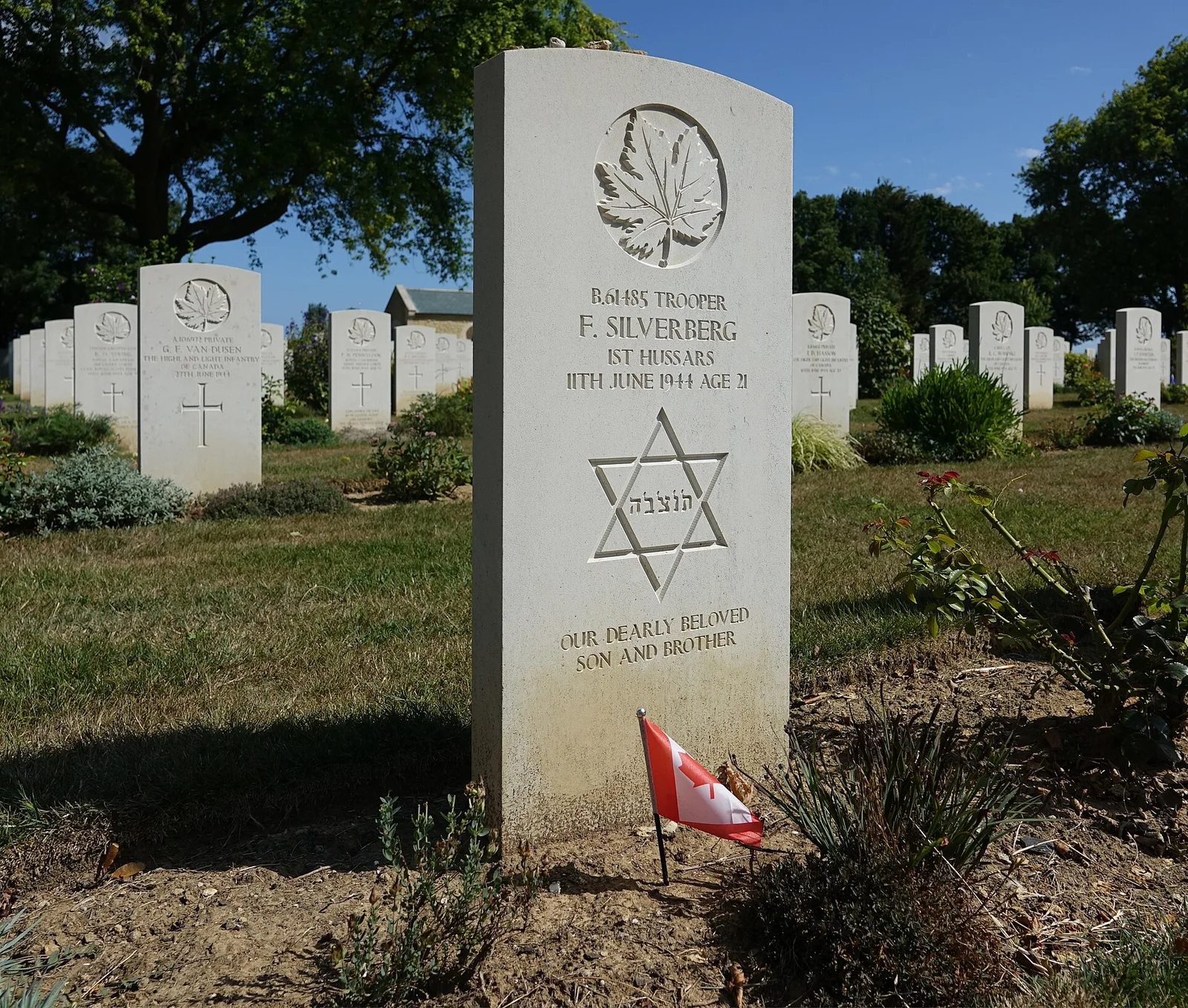
The graves are laid out in plots, beneath the pines and maples. Each headstone tells a different story, the CWGC reminds visiting schools. Its resource asks pupils to note the rank, the unit and the date of death on each stone they find. A few headstones carry the Star of David instead of a cross.
Finding a grave at Bény-sur-Mer before you travel
The search is best done at home, the evening before. Without a reference, finding one name means walking whole rows, and the light or the weather do not always allow that.
The first tool is Canadian. The Canadian Virtual War Memorial, run by Veterans Affairs Canada, honours more than 118,000 Canadians and Newfoundlanders who died in uniform since Confederation. Its advanced search filters by surname, unit or regiment, date of death and cemetery. Another filter shows only the profiles that include photos.
The second tool belongs to the CWGC, the site the Cœur de Nacre tourist office points visitors to. The Commission cares for the cemetery, and its records give each soldier a reference in three parts: plot, row and grave. Its school resource gives examples. Walter Brown is buried in Plot XIII, Row C, Grave 1. John MacNaughton, killed leading his men on D-Day, lies in the very first plot, Plot One, Row G, Grave 8.
The same leaflet mentions two brothers, Lawrence and Louis Chartrand, buried in two different plots. A family that comes for one name sometimes finds a second.
To go further than the grave itself, the full service file is requested from Library and Archives Canada, the Canadian Virtual War Memorial page explains.
Good to know. Write down the full reference before you leave: the plot in Roman numerals, the row as a letter, the grave as a number. A screenshot works too. The Cœur de Nacre tourist office also offers a free leaflet for touring the cemetery on your own, available at its Courseulles-sur-Mer office.
A day out from Anisy
The cemetery pairs naturally with the Juno Beach sector, and every stop is close by.
| Stop | What you see | Distance from Anisy | By car |
|---|---|---|---|
| Bény-Reviers Canadian cemetery | 2,049 graves, the Cross of Sacrifice, the platforms | 9 km | 12 min |
| Juno Beach Centre, Courseulles-sur-Mer | Canada’s museum on the D-Day beaches | 13 km | 16 min |
| Bernières-sur-Mer | The Queen’s Own Rifles landing beach | 12 km | 15 min |
| Ardenne Abbey | The Canadian memorial garden | 7 km | 13 min |
| Bretteville-sur-Laize Canadian cemetery | 2,793 Canadian graves, south of Caen | 28 km | 30 min |
Driving times calculated on 19 November 2026 with the free OSRM route planner, without traffic, from the centre of Anisy. Coordinates taken from OpenStreetMap and from the Juno Beach Centre practical page.
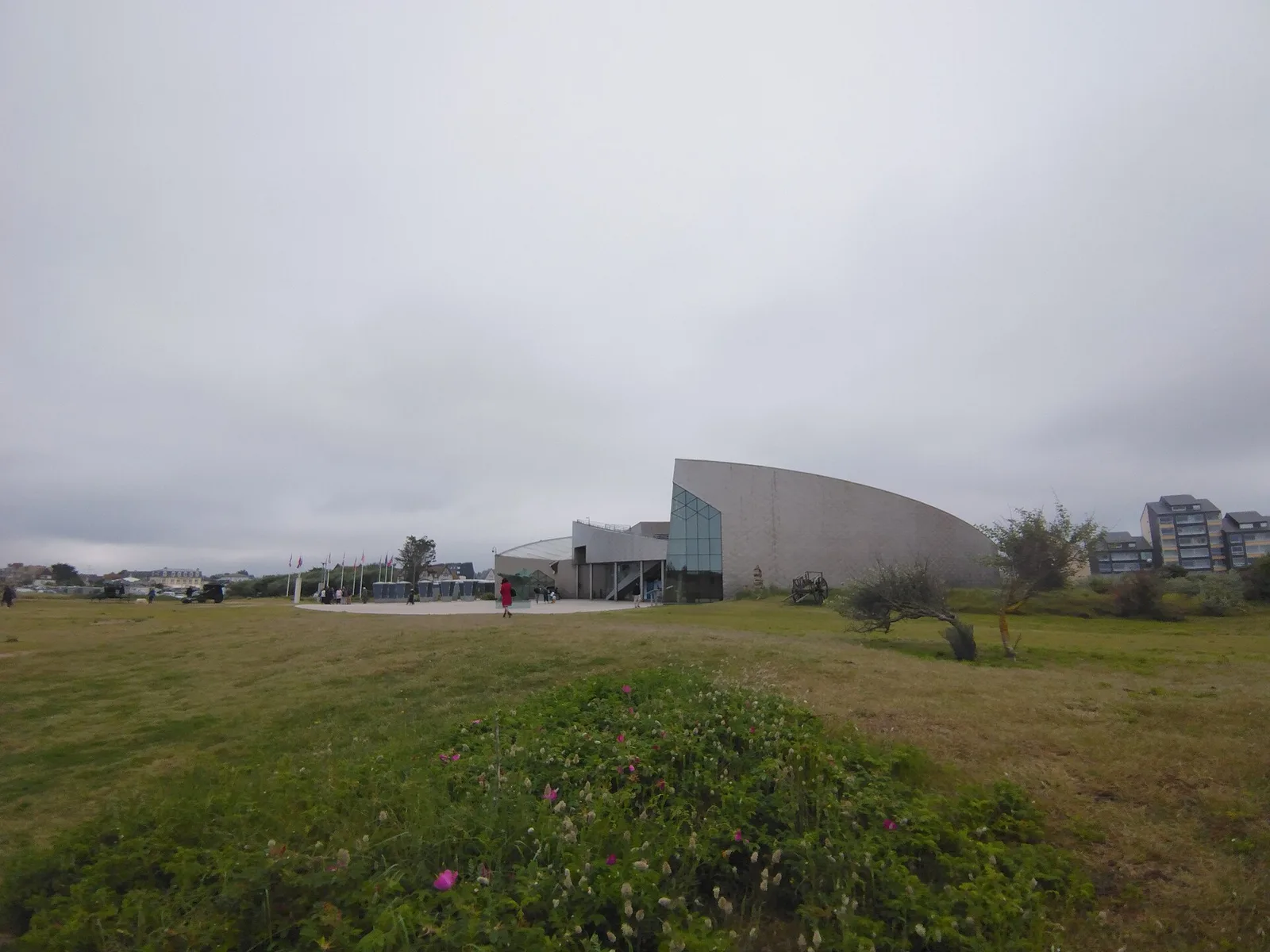
Morning: the Juno Beach Centre
Start in Courseulles-sur-Mer at the Juno Beach Centre. The museum recommends at least an hour and a half for a visit, and its free parking is only open during museum hours (Juno Beach Centre). You then reach the cemetery with regiment names in mind, and the headstones read differently.
Midday: the beach at Bernières
The Queen’s Own Rifles of Canada touched down at Bernières at 08:12 (Queen’s Own Rifles museum). The regiment’s museum counts 61 other ranks killed in action or died of wounds that day. The rest of the sector, from Graye to Saint-Aubin, is covered in the journal’s guide to the Canadian sector in one day.
Afternoon: Bény-Reviers
Head inland in the early afternoon. On 6 June the battalion followed this same axis, through Bény-sur-Mer, Basly and Colomby-sur-Thaon, up to Anguerny Heights, reached at 17:30. Allow a full hour at the cemetery, longer if you are looking for one grave.
Evening: back through Anisy
That evening the battalion’s most advanced position was the village of Anisy, taken by D Company, the regiment’s museum records. The Canadians covered twelve kilometres from the beach to reach Anisy and Mathieu, says the Cœur de Nacre page on Anisy. Their whole day, from the beach to the village, is told in the journal’s piece on the Queen’s Own Rifles at Anisy.
Practical guide around Bény-Reviers
Commonwealth war cemeteries are free to visit. The paid museum of the day links to its official page for opening hours and prices.
Bény-Reviers Canadian cemetery
- What you see: 2,049 graves, the Stone of Remembrance, the Cross of Sacrifice and the viewing platforms.
- From Anisy: 12 minutes.
- Admission: free, all year, with free parking and room for coaches (Cœur de Nacre).
- Good to know: the postal address says Bény-sur-Mer, but the site stands on the D35, north of Reviers.
The Juno Beach Centre
- What you see: Canada’s museum on the D-Day beaches, facing the sand at Courseulles-sur-Mer.
- From Anisy: 16 minutes.
- Admission: paid, opening hours and prices on the official site.
- Good to know: closed in January and on 25 December.
Ardenne Abbey
- What you see: the Canadian memorial garden, on the western edge of Caen.
- From Anisy: 13 minutes.
- Admission: the garden is open every day, according to Caen la mer Tourisme.
- Good to know: 21 Canadian prisoners were executed there in June 1944; their bodies were only found in 1945.
Bretteville-sur-Laize Canadian cemetery
- What you see: 2,793 Canadian soldiers, 91 of them unknown, and 79 members of the RCAF.
- From Anisy: 30 minutes.
- Admission: a CWGC cemetery beside the Falaise road, about 14 km from Caen (Veterans Affairs Canada).
- Good to know: almost every unit of the 2nd Canadian Corps is represented there.
Why stay north of Caen for Bény-sur-Mer Canadian War Cemetery?
From the north of Caen, the cemetery is 12 minutes away and the Juno Beach Centre 16 minutes. That makes it easy to come back on a second day, unhurried, if the first visit was not enough to find a grave.
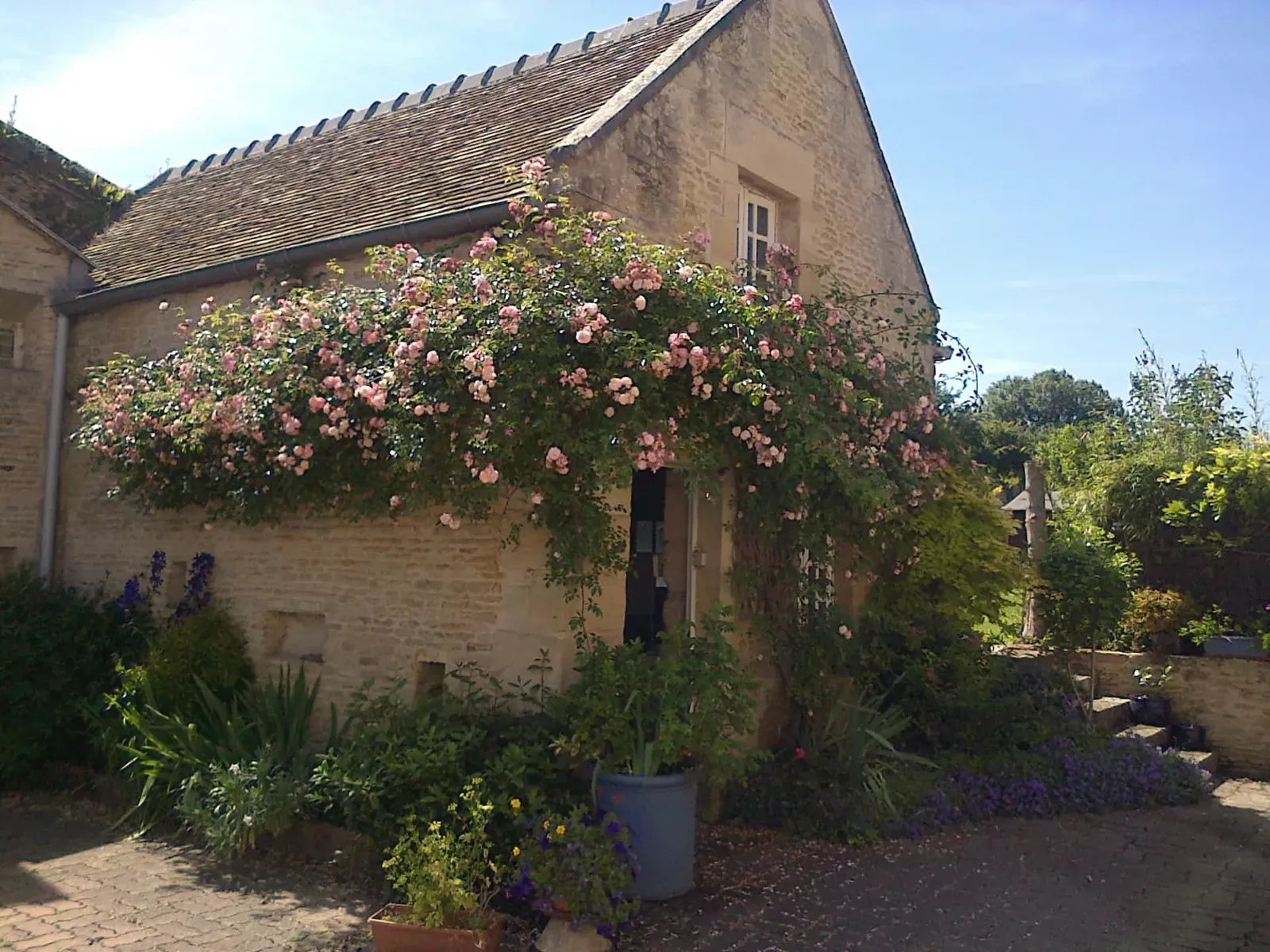
La maison bleue is a small stone cottage sleeping four, in a village of about seven hundred people. There are no shops or restaurants in the village, so a list of restaurant addresses waits on the fridge. Parking is free in the street. Two guests wrote this after their stay:
"Perfect location to explore the beaches and different locations from D-Day." Martin, July 2026
"The location is perfect for heading out to any place in the Normandy region." James, July 2022
Free dates and the price of each night are shown in the cottage calendar. Your booking request goes straight to Patricia, who replies in English, French or Italian.
Tips for a visit to the cemetery
Arrive with the grave reference already written down, along with the soldier’s full name, unit and date of death. Those three details settle any doubt between two men with the same name. On site, follow the Roman numerals of the plots first, then the letters of the rows.
Bring closed shoes, since the grass can be soaked in autumn and winter. A photo of the headstone and its row keeps an exact record of the reference for family back home.
On a first trip, keep the cemetery for the afternoon. A morning at the Juno Beach Centre gives you the context, and the afternoon leaves time to search without rushing. The low late-day light also brings out the carved inscriptions.
Key takeaway. Bény-sur-Mer Canadian War Cemetery stands on the D35 at Reviers, 12 minutes from Anisy. It is free and open all year. For one particular grave, note the plot, row and number before you leave, using the Canadian Virtual War Memorial and the CWGC records.
Frequently asked questions
Is the cemetery in Bény-sur-Mer or in Reviers?
It carries the name of Bény-sur-Mer, but it lies near the village of Reviers. The tourist office places it on the D35, north of the village. The postal address remains Bény-sur-Mer.
Is a ticket or a booking needed?
No, entry is free and needs no booking, all year round. A free car park also takes coaches. Groups are welcome, according to Normandy Tourism.
How can you check whether a relative is buried at Bény-sur-Mer?
Search his name in the Canadian Virtual War Memorial, using the cemetery filter. The CWGC records then give the plot, row and grave. The full service file is requested from Library and Archives Canada.
Are all the Canadians who died in Normandy buried here?
No. The second Canadian cemetery in Normandy is at Bretteville-sur-Laize, between Caen and Falaise. It holds 2,793 Canadian soldiers from almost every unit of the 2nd Corps.
How long should you allow on site?
An hour is enough to walk the central path from the gate and climb one of the two platforms. A grave search takes longer, especially without a reference. Allow half a day with the Juno Beach Centre, 16 minutes away by car.